Kenne Gregoire exhibits wonderful mastery of the manipulation of space and perspective within his still life paintings. The illusion of space is both present and deconstructed through the use of his flattened back washes of tile and table cloth in these two particular cases. Cups, plates, and vases appear elongated and stretched in a way that would not be possible, however, within his works this world he has created feels almost obtainable. The glass wear can all be used and the bread can be eaten. You can impose yourself into the scene and imagine enjoying what is presented to you however you would have to fight with yourself on the simple task of how to stand up for instance when the floor appears to go straight up. This interplay between space and flatness is where his works achieve such a grand success. Not only can he manipulate space, but he can also present a beautiful sense of flesh and individuality within his portrait and figure works. In the 5th work depicted, the female nude lays sprawled on the bed sheets. My interest is drawn to this work in particular but does not lay within the female form, nor the bed sheets and their pattern, but within the place of contact between her body and the bed sheets. In this painting, more so than the painting above, she almost appears flattened against the sheets in yet another realm that the idea of space is both welcomed and ignored.
Sunday, 22 September 2013
Sunday, 15 September 2013
Aron Wiesenfeld: A Suggested Narative
Aron Wisenfeld's paintings and drawings depict a world of elongated figures who dwell between the world of individuality and a figure who can potentially be occupied by whoever the viewer may choose. In an article in Hi Fructose of July, 2012, Wiesenfeld explains, "[t]here are no narratives in my paintings really, only suggestions of them, which I hope will provoke viewers to do their own story telling. My ideal audience member would be both the protagonist in the story and at the same time its co-creator." (a link to the pdf of this article for any further reading http://www.aronwiesenfeld.com/assets/Hi%20Fructose%2022.pdf) By providing only the setting and simplistic actions and props in order to prompt the viewer into coming up with their own "story" as to who these individuals are, and what they are doing, about to do, ponder, say etc. is what I find particularly intriguing. Wisenfeld was previously a comic book artist where the images often went along with the story coherently and with great purpose. Here, only an image communicates to the viewer leaving many questions and possibilities. In regards to technique, it is the handling of his tools in both graphite and oils that are quite impressive. The believability of the world he creates within his paintings, and the quietness that I find to exist within each work allows his created world to be inhabited by the imposing viewers thoughts in attempts to occupy the silence.
http://www.aronwiesenfeld.com/index.html
Friday, 6 September 2013
Ilya Repin: Master of the Gaze (1844 - 1930)
Ilya Repin was a Russian painter, born in the Ukraine, who often depicted the hardships of the low class people in society. In, Barge Haulers on the Vulga (5th painting of the bunch), Repin depicts the ferocity of the labour being expected of these men as they almost collapse in sure exhaustion, only to be held up by the harnesses attaching them to the mighty vessel they tow.
But now to mention the gaze, what I believe to be his most powerful and triumphant tool within his artistic practice. His portraits have the power to stare into you and allow for a momentary lapse of recognition that only a painting stands before you. In Repin's portrait of Vselvolod Garshin, (4th painting) a Russian author of short stories, the exhaustion of this fella's body can be sensed within his glazed over stare. His psychological state is only enhanced by his disheveled hair, hunched over back and books and papers askew. The contrast between his black coat and white background allow you to simply only focus on his gaze and the books atop the table. For that matter, almost all the portraits posted take on this same effect of contrasting backdrops which lack depth. Overall a marvelous painter in the study of portraiture.
Saturday, 31 August 2013
Edgar Degas: The Sketches
Edgar Degas, a master of the line. The top-most image is my personal favourite sketch in the bunch. Within such few lines and simplified forms Degas is able to capture the physique as well as the attitude of this character. I say character because for the most part, the individuals Degas depicts seem to be void of individuality and fit within a certain class of people as a whole, whether a dancer or flaneur. The individuality of a figure is second to their energy.
Saturday, 24 August 2013
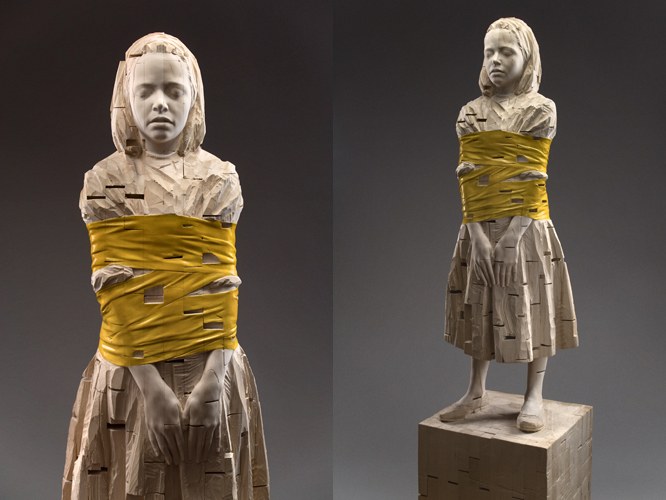
Gehard Demetz: Blocks of wood
Gehard Demetz constructs figures from small blocks of wood combining finely polished areas of soft features against the rough areas of combined wood blocks and freshly chiseled sections. The figures, always children, are always in the process of some form of restraint upon themselves as an individual. They become "bodies" and not a singular person in any respect. However, they are presented to us with such skill, if you ponder into only they're faces it is easy to forget they are simple blocks of wood.
http://www.geharddemetz.com/index.asp
Friday, 16 August 2013
Jeremy Mann: Modern Master
San Francisco artist Jeremy Mann stems from a very traditional approach to painting however diverges with his use of colour and mark making techniques. Both the subject matter and application of paint often suggests movements and creates interesting dynamics and emotions within each painting. He also ventures into landscape and cityscape paintings as well as still lifes.
http://www.redrabbit7.com/
Émile Friant: 1863-1932
It's the direction of the male figures gaze and the opposing female figure's downward stare along with strong cast shadows that really catches my attention.
Subscribe to:
Posts (Atom)